
India Battery Energy Storage System (BESS) Market Size, Share, Report 2026 - 2035
India Battery Energy Storage System (BESS) Market (By Battery Type: Lithium-ion Battery, Advanced Lead-acid Battery, Flow Battery, Sodium-ion Battery; By Connection Type: On-grid, Off-grid; By Ownership: Customer Owned, Third-party Owned, Utility Owned; By Application: Residential, Commercial & Industrial, Utility) - Global Industry Analysis, Size, Share, Analysis, Trends and Forecast 2026 - 2035
- Last Updated: 21 Apr 2026
- Report Code: ARC3891
- Category: Energy and Power
India Battery Energy Storage System (BESS) Market Size and Forecast 2026 - 2035
The India battery energy storage system (BESS) market registered a revenue of USD 2,188.1 million in 2025 and is estimated to achieve of USD 19,445.2 million by 2035 growing at a CAGR of 24.3% from 2026 to 2035. The supportive government initiatives including Viability Gap Funding (VGF) and Production Linked Incentive (PLI) are proliferating the growth of the market. Furthermore, the declining cost of lithium-ion battery is opportunistic for the BESS market demand.
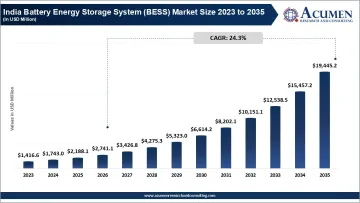
Report Highlights
- By Battery Type, the lithium-ion battery segment represented 72% of the total India BESS market share in 2025.
- By Connection Type, on-grid systems accounted for 79% of the total market share in 2025.
- By Ownership, the utility owned system accrued a market share of 57% in 2025.
- By Application, the utility segment held over 62% market share in 2025.
Battery Energy Storage System Market Overview
A Battery Energy Storage System (BESS) refers to a type of technology that involves the storage of electrical energy in rechargeable batteries to supply back when needed. This enables the balancing of electricity supply and demand, improves the stability of the electricity supply, as well as helps to integrate renewable power sources like solar and wind energies.
The transition to renewable energy and decarbonization goals are major drivers of the BESS market. Government policies, incentives, and regulations for reducing carbon emission push investment in energy storage projects across the globe. Additionally, an increase in power outages and the need for resiliency in energy infrastructure have driven demand for large-scale and distributed BESS solutions.
Another major driver of growth has been the ongoing sharp fall in the cost of batteries and advancements related to energy storage, especially lithium-ion batteries. Advances in the energy density, safety, and durability of these storage solutions have made grid-scaled BESS a viable commercial reality for a range of utility power, commercial, and residential uses. The growing EV market is also developing its battery ecosystem and helping to reduce costs. On the other hand, rising energy requirements, urbanization, and a more decentralized energy network, especially through micro-grids and Virtual Power Plants, are providing development opportunities for grid-scaled BESS.
India Battery Energy Storage System Market Dynamics
Market Drivers
Declining Costs of Batteries
- Decreasing lithium-ion battery prices are making BESS solutions viable for large-scale deployment in the country. Economies of scale, improved manufacturing efficiencies, and supply chain optimizations result in lower battery costs. The below graph illustrates a steady downturn in the price of volumes-weighted averages for Li-ion batteries from USD 475 per kWh in 2015 to a price of USD 108 per kWh in 2025. Overall, there is a steady downward trend in prices resulting from various factors such as developments in technology and economies of scale, although a slight short-term spurt is witnessed for 2022 due to commodity price variations.
Supportive Government Policies
- The Viability Gap Funding Scheme, launched by the Ministry of Power in June 2023, offers a one-time grant of over 40% of the eligible stand-alone BESS capex, capped at INR 6.6 crore per MW. By September 2024, this initiative had sanctioned 1,200 MWh across eight projects, worth INR 4,800 crore, triggering a private equity investment of USD 580 million. The PLI scheme for Advance Chemistry Cells, announced concurrently, offers a 6% sales reimbursement over five years, subject to 50% value addition within India and 5 GWh capacities, with Reliance, Ola Electric, and Rajesh Exports bagging 50 GWh capacity awards in 2024 with production planned for late 2025. These policies can narrow the difference in landed costs of imported vs. indigenous cell technology from 22% in 2023 to a range of 8% by 2027.
Market Restraints
Regulatory Ambiguity
- Cost recovery regulations differ by state, with some states considering BESS as generation form, while others consider it as transmission form. For projects involving tagged transactions in BESS, the returns are based on regulated tariff structures, determined 12-18 months after incurring the cost, which is not attractive for equity investments, where return certainty is sought. Sectoral guidelines for a new category with cost-plus tariff structures were proposed, but these regulations are pending as of end 2024. The SECI tariff caps, ranging between INR 5.50 and 6.00 per unit, reduce returns if WACC is above 11%. Lenders also ask for DSCR ratios above 1.4 times, suggesting a break-even tariff range of approximately 6.50 per unit. Uncertainty remains in Uttar Pradesh, Bihar, and West Bengal, where no orders for BESS projects are available for wheeling or banking charges.
High Capex Owing to Import-Heavy Battery Supply Chain
- In 2024, India imported over 85% of cells, adding over 18-22% to landed costs including GST, customs duty, freight, and working capital. The typical customs duty on cells is over 10% + 18% GST, while concessional duty routes necessitate advance authorization, which increases procurement by over two months. In 2024, the freight from Shenzhen to Mumbai averaged approximately USD 4,200 per container, amid Red Sea diversions; it amounted to USD 1,800 in 2022. Last-mile haulage to desert sites requires an additional USD 50-80 per kWh owing to the deployment of shock-resistant and specialized trailers. First-generation cell plants of India are projected to operate at 60-70% of the cost efficiency compared to Chinese plants till they reach an output of 10 GWh, maintaining high near-term reliance on import.
Market Opportunities
Rising Demand for Electric Vehicles (EVs)
- The electric vehicle (EV) industry in India is growing at a rapid pace due to various factors such as government support, environmental factors, and advancement in technology. Furthermore, with the help of the plans initiated by the Government of India through the Faster Adoption and Manufacture of Hybrid and Electric Vehicles (FAME) plan, India is planning to witness a substantial rise in the adoption of electric vehicles in the coming years. The Government of India has set a target for boosting the current electric vehicle sales to 30% of private cars, 70% of commercial vehicles, 40% of all buses, and 80% of two/three-wheelers by 2030 and plan to see an approximate 80 million electric vehicles running in India in addition to 'Make in India' for complete domestic EV product manufacture plans. The rapidly developing EV market is reinforcing the broader ecosystem for battery manufacturing, which concurrently benefits the BESS industry. Mass production of EV batteries enables technology advancement. It decreases total costs of battery production, thereby creating a pathway for more cost-effective and higher performance energy storage solutions and added revenue opportunities in battery reuse and second-life applications.
Development of Microgrids and Smart Grids
- The increasing demand for micro-grids, as well as smart grids, in India presents considerable growth potential for the Battery Energy Storage Systems (BESS) market. With an increasing number of renewables, micro-grids are increasingly recognized as critical to providing decent access to electricity to remote areas, along with mitigating stress on the power grid. Smart grids, with digital monitoring systems, automated operations, and real-time energy management, require highly efficient storage systems to mitigate fluctuations arising from intermittent solar and wind patterns. Government plans to modernize grids through various programs related to access to new energy resources add to these growth stimulators for the BESS market.
India Battery Energy Storage System Market Report Scope
| Attribute | Details |
|---|---|
| India Battery Energy Storage System Market Size 2025 | USD 2,188.1 Million |
| India Battery Energy Storage System Market Forecast 2035 | USD 19,445.2 Million |
| India Battery Energy Storage System Market CAGR During 2026 - 2035 | 24.3% |
| Analysis Period | 2023 – 2035 |
| Base Year | 2025 |
| Forecast Data | 2026 - 2035 |
| Segments Covered | By Battery Type, By Connection Type, By Ownership, and By Application |
| Key Companies Profiled | Tata Power Renewable Energy Ltd., AES Corporation (Fluence JV), Reliance New Energy Ltd., Exide Energy Solutions Ltd., Amara Raja Energy & Mobility Ltd., Adani Energy Solutions Ltd., JSW Energy Ltd., CATL, LG Energy Solution Ltd., and Panasonic Holdings Corp. |
| Report Coverage | Market Trends, Drivers, Restraints, Competitive Analysis, Player Profiling, Covid-19 Analysis, Regulation Analysis |
India Battery Energy Storage System Market Segmental Insights
The worldwide market for battery energy storage system (BESS) is split based on battery type, connection type, ownership, and application.
Battery Type Insights
Based on battery type, the market is classified into lithium-ion battery, advanced lead-acid battery, flow battery, and sodium-ion battery.
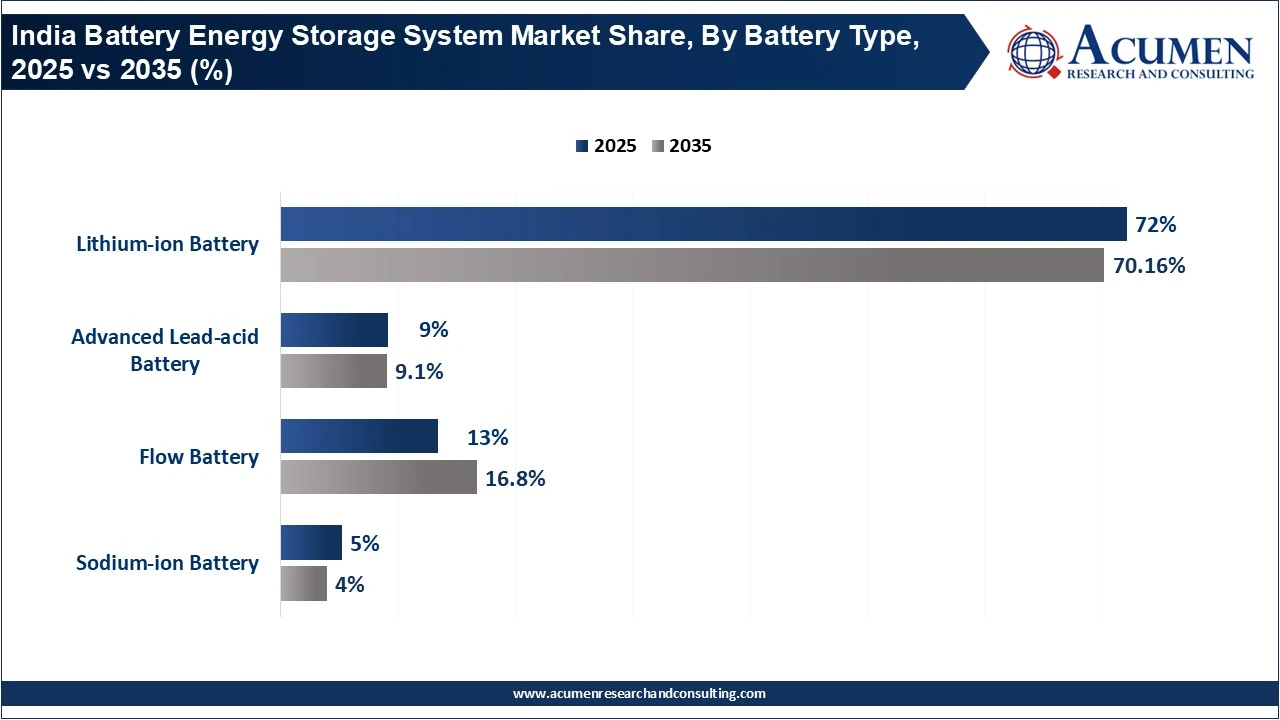
Lithium-ion batteries are currently the leading technology in the India BESS market due to their better energy density, response time, and efficiency over alternative battery solutions. The lithium-ion battery market is also harnessing the popularity of their application in electric vehicles. This has helped to optimize cost savings via mass production of components in factories. The lithium-ion battery market serves the need of residential, commercial, as well as utility-scale applications. Therefore, it has become the predominant market for storage of power. In September 2025, the Union Minister of Electronics and Information Technology inaugurated advanced state-of-the-art plant of lithium-ion battery in Sohna, Haryana. The new facility is purposed to manufacture over 20 crore battery packs per year, meeting over 40% of India’s demand. It is also projected to create over 5000 jobs.
| Battery Type | Market Share, 2025 (%) | Key Highlights |
|---|---|---|
| Lithium-ion Battery | 72% | Dominant due to high energy density, declining costs, fast response time, and widespread use across residential, commercial, and utility-scale storage. |
| Advanced Lead-acid Battery | 9% | Deployed in cost-sensitive and backup applications, specifically in remote and small-scale systems. |
| Flow Battery | 13% | Gaining popularity in utility-scale and long-duration storage owing to scalability and long lifespan, specifically for renewable integration. |
| Sodium-ion Battery | 5% | Emerging alternative owing to lower material costs and reduced dependency on lithium, primarily in pilot and early deployment stages. |
Connection Type Insights
On-grid systems dominate the BESS market in India, as governments and utilities within power grids are focusing more on modernizing existing grids for accommodating renewable energy. In addition, it is being heavily invested in for frequency regulation, peak shaving, and balancing renewable power capacities. Urbanization and rising demand for electricity across both developed and developing economies will continue to drive this market dominance. In November 2025, Adani Group announced its strategic entry into the BESS sector with the largest BESS installation in India and one of the largest single-location deployment of BESS in the world. The project is expected to be commissioned in March 2026. The BESS deployment is purposed to improve grid reliability and stability.
| Connection Type | Market Share, 2025 (%) | Key Highlights |
|---|---|---|
| On-grid | 79% | Dominant due to large-scale grid stabilization projects, utility investments, and renewable integration. |
| Off-grid | 21% | Growing rapidly in remote and rural electrification, island grids, and solar & storage microgrid applications. |
Ownership Insights
Based on ownership, the market is classified into customer owned, third-party owned, and utility owned.
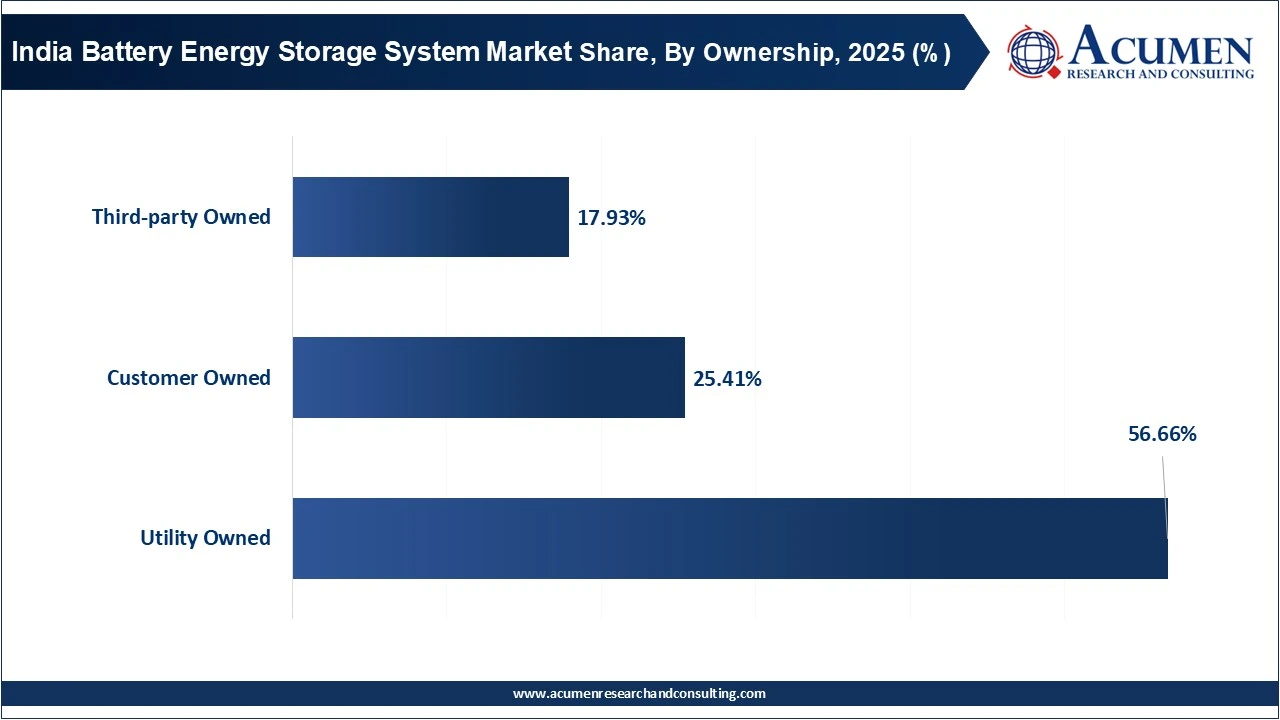
The utility-owned BESS, is the largest market because of the rise in the number of large-scale grid storage systems across the country. The project initiated by the utilities will drive the growth of the industry as the firms will utilize the storage system as a tool for supporting the connection of the renewables to the grids, as well as peaker plants that rely on fossil fuel sources for the generation of electricity. In April 2025, IndiGrid announced the completion of India’s first regulated utility BESS project. The project includes 20MW/40MWh utility-scale standalone BESS in Delhi.
| Ownership Type | Market Share, 2025 (%) | Key Highlights |
|---|---|---|
| Utility Owned | 57% | Dominant due to deployment of grid-scale projects by governments and power utilities for grid stability and load balancing. |
| Customer Owned | 25% | Installed in residential and commercial sectors for backup power and energy bill optimization. |
| Third-party Owned | 18% | Fast-growing model owing to reduced upfront cost for end users. |
Application Insights
The utility application continues to position itself firmly in the market due to extensive investment in capital related to the storage of energy capacity that covers large utility-scale applications. The sector has seen heavy investment by the utilities in battery energy storage solutions for applications such as frequency management and responsively managing peak loads as well as managing the variables of renewable resources. In November 2025, ENGIE announced its strategic entry into India’s utility-scale energy storage sector with the launch of a 280 MW battery project.
| Application | Market Share, 2025 (%) | Key Highlights |
|---|---|---|
| Utility | 62% | Dominant due to increasing deployment of grid-scale storage projects for renewable integration and frequency regulation. |
| Commercial & Industrial | 26% | Fastest growing segment due to energy cost optimization, peak load management, and power reliability needs. |
| Residential | 12% | Driven by rooftop solar adoption, backup power needs, and increasing electrification of homes. |
India Battery Energy Storage System Market Players
- Tata Power Renewable Energy Ltd.
- AES Corporation (Fluence JV)
- Reliance New Energy Ltd.
- Exide Energy Solutions Ltd.
- Amara Raja Energy & Mobility Ltd.
- Adani Energy Solutions Ltd.
- JSW Energy Ltd.
- CATL
- LG Energy Solution Ltd.
- Panasonic Holdings Corp.
India Battery Energy Storage System Market Segmentation
By Battery Type
- Lithium-ion Battery
- Advanced Lead-acid Battery
- Flow Battery
- Sodium-ion Battery
By Connection Type
- On-grid
- Off-grid
By Ownership
- Customer Owned
- Third-party Owned
- Utility Owned
By Application
- Residential
- Commercial & Industrial
- Utility
Looking for discounts, bulk pricing, or custom solutions? Contact us today at sales@acumenresearchandconsulting.com
Frequently Asked Questions

Other Energy and Power Reports
March 2024
December 2020
October 2024
March 2023